Technology & power
Jensen Huang’s letter: How does a private affair reach the chip war?
A Taipei gathering. A Singapore chip buyer. A short report published months before the headlines. The full reading edition of Gist EP2 follows the business and political questions behind Huang’s apology.
Key takeaways
- On November 8, 2026 Huang acknowledged infidelity. The board opened an inquiry because reporting said he was the target of a foreign-intelligence effort.
- The figures for Megaspeed’s purchases are reporting to investigate. They do not show that a personal relationship caused the orders.
- Culper’s dollar amounts are a short seller’s allegations. The film treats the $4.6 billion and $4.8 billion figures as different scopes.
Taken from this text.
This is the full reading edition of Gist EP2, The Chip King’s Secret, following all eight chapters of the film. It reflects the story as presented when the video was published on November 9, 2026. A subsequent official update appears separately at the end.
How does a private affair reach the chip war?
“I can get Jensen Huang to come over.”
In June 2024, a woman at a Taipei bar reportedly said she could bring NVIDIA’s chief executive to the gathering. Huang subsequently arrived.
At the time, it sounded like an anecdote about access to a technology celebrity. Two years later, reports about an American intelligence assessment put that evening in a different context: a customer relationship, billions of dollars in equipment purchases, and Washington’s restrictions on advanced technology reaching China.
On November 8, 2026, Huang publicly acknowledged marital infidelity in a letter to employees. NVIDIA’s board announced an independent investigation into national security concerns raised in reporting. Together, the statements turned a private matter into a major corporate and political story.
Another thread had emerged months earlier. In May, a US short seller had already singled out the company associated with the woman and announced a bet against NVIDIA.
The film follows those intersecting threads. Why might a personal scandal prompt renewed scrutiny of the chip trade? The story begins in Taipei.
That evening in Taipei
During Computex week in 2024, Huang drew crowds across Taipei. Autographs, photographs and night-market visits became part of a public tour by one of technology’s most recognizable executives.
The film recounts a New York Times interview with a technology executive who attended the bar gathering. According to that account, Alice Huang, also known as Huang Le, a senior figure associated with Singapore-based Megaspeed, said she could bring Huang over. NVIDIA offered a different explanation: he had already intended to attend.
The film also describes reporting that Megaspeed began receiving a regular supply of NVIDIA products weeks later, purchasing roughly $1 billion in the first three months and another $1 billion over the following nine. The timing raises questions to investigate. It does not, by itself, establish that a personal relationship caused the purchases.
Photographs placed the two at a Taipei restaurant the following year. In a CNN segment included in the film, a reporter revisits the restaurant, known for chicken soup and frequented by Huang. A member of staff says she does not remember the woman in the photograph. The visit illustrates the reporting process; it does not independently establish the nature of their relationship.
The consequential question lies behind those encounters: what was Megaspeed buying, and where did the equipment end up?
A company that was hard to find
The reporting summarized in the film describes Megaspeed as a company formed in 2023 from a Chinese cloud-gaming business, with a Singapore headquarters and a Malaysian affiliate, Speedmatrix. It reportedly bought close to $2 billion in NVIDIA products in its first year.
That scale attracted attention. The film recounts a US Commerce Department inspection of a Malaysian data center in 2024 that found equipment still in boxes. Investigators considered the situation suspicious. Unopened boxes alone, however, cannot prove illegal diversion.
CNN visited the Singapore office. In the segment, the reporter describes an office manager who had joined only months earlier, an apparently empty office behind her, and her account that the bosses were generally in China and rarely visited. The contrast between the physical office and the reported trade was striking.
The CNN footage also cites ImportGenius researcher William George, who had spent more than a year following relevant shipments. The report describes approximately $4.8 billion in equipment transactions over two years, some involving a Chinese technology company blacklisted by Washington. This figure covers equipment incorporating NVIDIA chips and technology; it should not be treated as an identical amount of direct NVIDIA chip revenue.
An interviewee explains why American AI and AI-hardware leaders would be high-priority intelligence targets. That provides context for the concern. It does not prove that any particular meeting was an intelligence operation.
The short report that came first
On May 13, 2026, Culper Research published a report announcing a short position in NVIDIA. Its central argument was that investors underestimated the company’s exposure to Chinese demand through Southeast Asian customers.
The film identifies the report’s principal claims: $2.9 billion in refundable deposits on Megaspeed’s books; a funding connection Culper attributed to Alibaba; and roughly $4.6 billion in server imports by Speedmatrix between December 2024 and January 2026. Culper estimated that more than one-fifth of NVIDIA’s fiscal 2026 compute revenue could remain connected to Chinese demand. These are the short seller’s allegations and calculations, not a revenue breakdown endorsed by NVIDIA. [4]
The $4.6 billion figure and the earlier $4.8 billion figure are not interchangeable. They come from different reporting periods and scopes. Both invite questions about scale and end use; they do not automatically validate every allegation in either account.
Three qualifications matter. Culper stands to benefit if NVIDIA’s shares fall. Its report did not present its findings as proof that NVIDIA had broken the law. And, as the film recalls, NVIDIA’s stock rose to a 52-week high on the report’s publication day. A market reaction shows how investors traded, not which claims were true.
NVIDIA told reporters it had previously investigated and rejected allegations of Megaspeed diverting chips. It described customer meetings as routine executive work and the information shared as ordinary business information. Chinese officials rejected the intelligence allegations as unfounded. Megaspeed told the Times it had retained outside counsel and was committed to cooperating with the US government. [5]
One letter, three phrases
On October 29, the New York Times reported US officials’ intelligence assessment of Alice Huang and said President Donald Trump had been briefed approximately a year earlier. The Financial Times subsequently reported on a government memorandum describing the relationship. Congressional committees sought an explanation. This is the reporting sequence covered in the film, not a complete public release of the underlying intelligence.
Huang’s November 8 letter arrived against that backdrop. Gist reads it through three phrases: infidelity, target, and American.
Infidelity
Huang admitted being unfaithful to his wife, apologized for hurting his family, and accepted responsibility. He did not identify the other person. That distinction matters: the letter cannot be cited as his confirmation of a name supplied by separate reporting. [1]
Target
The board’s statement addressed reports that Huang had been the target of a foreign intelligence operation. It announced an independent investigation and said it had no reason at that point to believe national security or company secrets had been compromised. [2]
The film interprets the wording as positioning Huang as someone potentially targeted. That is an analysis of the language, not a finding about his knowledge or conduct. Announcing an investigation does not establish a leak; expressing confidence does not settle the investigation either.
American
Near the end of the letter, Huang discusses cooperation with the inquiry, protecting the company and US national security, and his pride and gratitude in being American. Gist reads this as a response to a question of trust in Washington as well as an apology. That is the film’s interpretation, not an explanation Huang has given of his communications strategy.
The film then asks a corporate-governance question. How does a company worth trillions investigate a founder on whom it depends so heavily? CNN commentary contrasts the situation with other companies’ responses to executive scandals. Gist asks how much of the board’s support reflects confidence and how much may reflect Huang’s perceived importance to the business.
Without the board’s internal deliberations, that remains a question—not an established account of its motives.
Why this goes beyond a personal scandal
Huang has been among the most prominent advocates of keeping American AI chips available to Chinese customers.
In the Bloomberg interview included in the film, he describes trying to persuade US policymakers that engagement with China matters, and argues that restrictions have created a difficult mistake to reverse. Another interview develops his reasoning: competition still requires dialogue, and keeping developers on American technology helps innovations and open-source contributions remain connected to the American ecosystem.
His concern is a split into two technological worlds: an open-source ecosystem running on Chinese technology, and a closed ecosystem running on American technology. In that argument, abandoning Chinese demand could push developers and business toward competitors such as Huawei.
The film recalls Trump opening a policy path for H200 sales to China in December 2025, with a US share of relevant sales proceeds. It also cites Reuters reporting that ten Chinese companies received American approval. US licensing, Chinese import permission and completed shipments are separate steps; an approved customer is not proof that all its orders were delivered.
The industrial argument can be debated on its merits. The additional question is whether intelligence concerns surrounding a leading advocate’s contacts will prompt Congress to revisit lobbying, customer screening and export arrangements. That does not establish that his policy position was caused by a private relationship.
The film presents semiconductor analyst Lu Hsing-chih’s “three cuts” interpretation as possible political consequences: weaken Huang’s credibility as an advocate, tighten H200 exports and Southeast Asian diversion routes, and use congressional and board investigations to constrain NVIDIA. These are scenarios, not three completed policy actions.
The clock in Washington
Huang’s relationship with Trump supplies another layer of context. The film includes White House events, a state dinner and public interactions. CNN recounts the Times reporting about an earlier intelligence briefing. Trump continued to praise Huang when questioned by reporters, while Marco Rubio declined to discuss details, citing the nature of the matter and internal corporate affairs.
Presidential support does not determine what Congress will do.
Three House committee chairs requested a joint closed-door briefing on Huang’s contacts with a Megaspeed executive and NVIDIA’s safeguards against foreign espionage. Their official announcement proposed November 18, 2026, and asked Huang to accept or offer alternative availability by November 11. This was a formal request, not confirmation that the session had been scheduled or held. [3]
The film describes a clock running toward a new Congress after the midterm elections. It mentions Democratic Senator Chris Coons’s call for answers and considers how a change in congressional control could affect subpoenas, hearings and the public visibility of an inquiry. A transition from private briefings to public hearings was a possibility being discussed, not an announced outcome.
Some commentators interpreted the timing of the apology as an attempt to acknowledge personal misconduct before the political process defined the story. The film identifies that as inference. Huang has not said that was his reason for publishing the letter.
What matters for Taiwan
The two widely discussed encounters took place in Taipei, making this feel like a nearby celebrity story. Taiwan’s more consequential connection is its role in NVIDIA’s manufacturing, testing and server supply chain.
The film cites estimates of NVIDIA-related revenue exposure of roughly 36% for KYEC, 21% for Wistron and 19% for TSMC. These figures were reported from Bloomberg-compiled data. They illustrate exposure and should not be read as a permanent share or each company’s latest officially disclosed quarterly breakdown. [6]
The film also notes Taiwan’s stock market rising more than 2,300 points intraday on November 9, amid National Stabilization Fund and regulatory measures. The point is to avoid attributing a market move to the personal scandal when other important factors were operating at the same time.
Gist’s focus is whether tighter export rules, customer scrutiny or governance changes could affect orders and industrial plans. News attention alone is not a supply-chain outcome. Policy and commercial decisions connect the two.
The film leaves viewers with two dates to watch: NVIDIA’s earnings release and call on November 17, US time, and the requested congressional briefing on November 18. The first offers an opportunity to hear management address business risks; the second concerns political accountability. Neither is a stock-price forecast or investment recommendation. [7]
What is established, and what remains open?
By the end of a story like this, separate pieces of information can start to sound like a completed case. The film closes by separating their evidentiary status.
- Supported by public documents: Huang acknowledged marital infidelity, NVIDIA’s board announced an independent investigation, and three House committee chairs requested a briefing.
- Reported or alleged, with underlying evidence not fully public: the intelligence assessment of Alice Huang, media descriptions of the relationship, the ultimate destinations of Megaspeed’s equipment, and Culper’s conclusions about financing and Chinese demand.
- Not determined by this article: whether sensitive information was passed, what it contained or affected, and what the investigations will conclude.
An apology is not an intelligence report. A short thesis is not a court finding. A company’s denial does not remove the need to examine the evidence.
Huang asked for his family’s privacy. This story concerns his public responsibilities, corporate governance and policy influence; it does not make his family responsible for his choices.
That brings us back to Culper. Did it identify a risk investors had overlooked, or arrange disparate clues into a story that served its position? The answer still depends on evidence about money, equipment and the investigations. That is why this story warrants attention beyond the affair itself.
An update after the film
On November 10, 2026, NVIDIA’s independent directors announced that former acting US Attorney for the Southern District of New York Joon H. Kim and Wachtell, Lipton, Rosen & Katz would conduct the investigation. That announcement names the investigators; it does not publish findings. The main narrative above retains the film’s November 9 perspective. [8]
Sources and reading notes
This edition adapts Gist’s original film and its interview excerpts. Spoken transitions, repetition and the sign-off have been removed while retaining the arguments and responses across the chapters. The links below provide official documents and selected reporting; allegations remain attributed to their respective sources.
- A Message to Our Company — NVIDIA, November 8, 2026.
- Statement From NVIDIA Board of Directors — November 8, 2026.
- House chairs request a briefing from Jensen Huang — US House of Representatives, November 5, 2026.
- Culper Research’s NVIDIA short report (PDF) — May 13, 2026. The author holds a short position.
- Nvidia Chief Seen as Target of Chinese Spy Plot — The New York Times, syndicated by GV Wire, October 29, 2026.
- Taiwan supply-chain exposure and analyst context — EBC, citing Bloomberg-compiled data, November 11, 2026; used to cross-check figures in the film.
- Third-quarter earnings call announcement — NVIDIA, October 28, 2026.
- Independent directors name the investigators — NVIDIA, November 10, 2026.
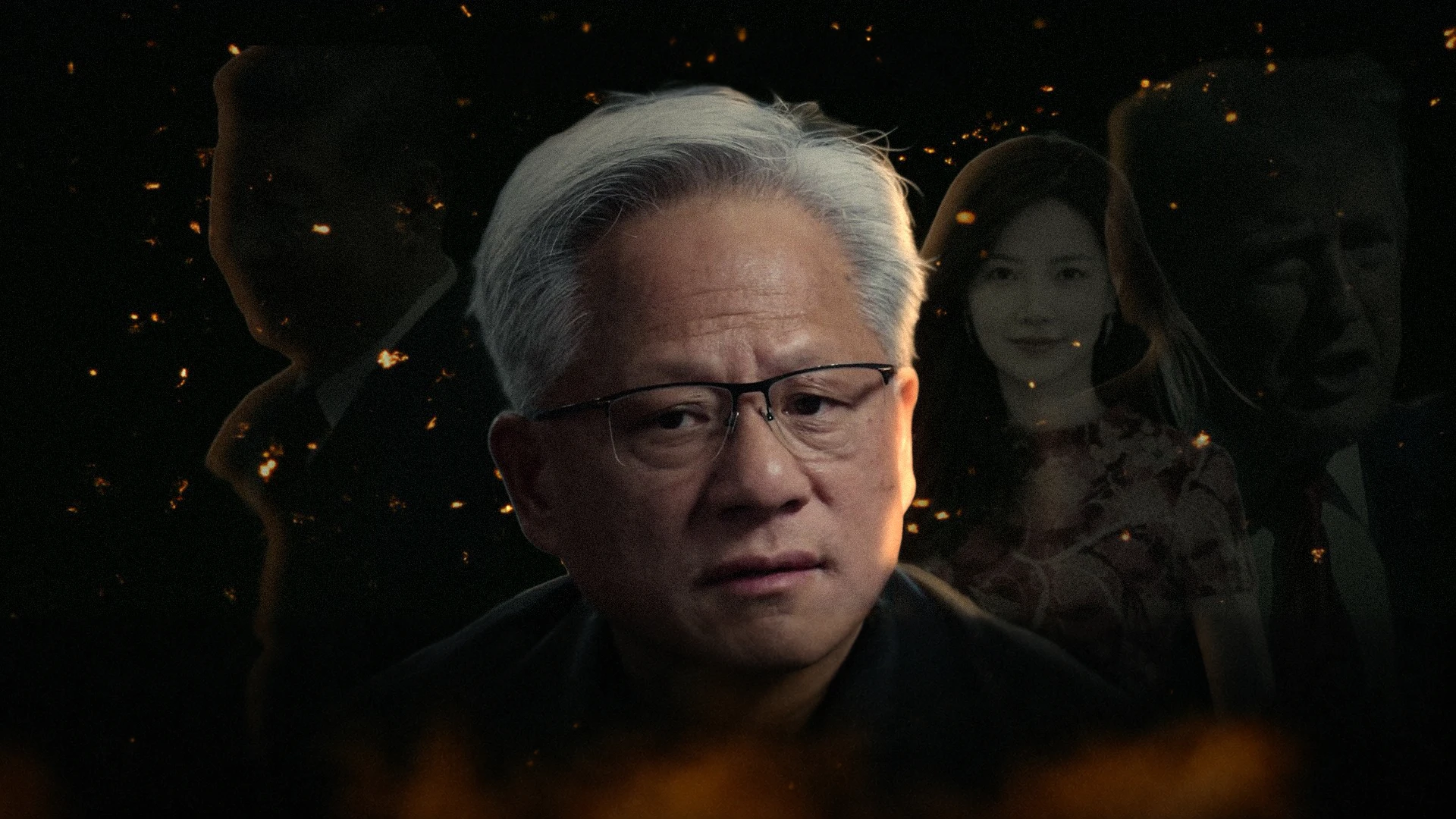
The cover is a composite illustration; some scenes in the film are AI illustrations. The film uses AI narration. This English reading edition does not add an English audio track to the original video.